
Arakan News Agency
There’s a man named John, aged somewhere in his 50s, who sometimes loiters near the entrance to the headquarters of the National League for Democracy (NLD), Myanmar’s ruling party as of one year ago. If you say hello to him, preferably in his native Burmese, there’s a very good chance that he will tell you all about the day the White Bridge turned red.
John says that on March 13, 1988, he was shot in the back — he readily displays a scar as evidence — and his college girlfriend was killed when police violently cracked down on a student protest that had morphed into an openly antigovernment march. The White Bridge atrocity was one of the early events that led to Myanmar’s 1988 uprising, which by August of that year had grown into a nationwide effort to overthrow the country’s brutal military regime. Authorities responded, predictably, with more brutality.
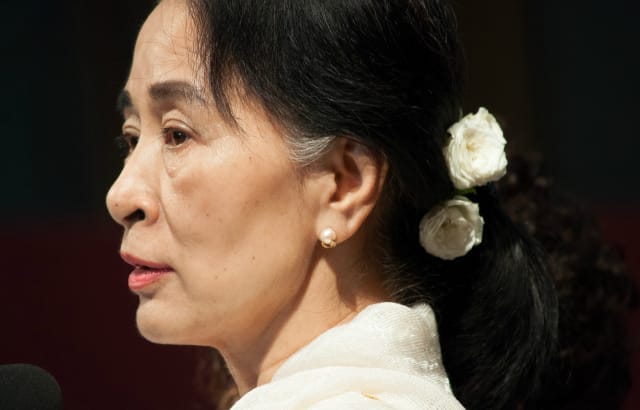
One year ago, on March 30 , the NLD was sworn in as Myanmar’s ruling party with a resounding majority after it swept the country’s first free election in decades on Nov. 8, 2015. The party, led by Nobel Peace Prize laureate Aung San Suu Kyi, now 71, was founded in the wake of the 88 popular uprising, and after a decades-long struggle she marshaled its members to a dramatic comeback and she became State Counselor, the country’s highest civilian role. This was the stuff of screenplays: in a rare vindication of history, a former political prisoner, the quiet and dignified daughter of the country’s late independence hero, stepped out of the sidelines to trounce the corrupt, inept and violent regime that had kept her in confinement for the better half of two decades.
“Expectations were extremely high for change, even as observers understood the constraints the NLD faced,” Derek Mitchell, the former U.S. ambassador to Myanmar, tells TIME. “That said, people do question whether the NLD, and Aung San Suu Kyi herself, have made the most of their first year in office.”
It was clear from the start that Suu Kyi’s task would be daunting for even the most adroit politician. The country’s constitution, drafted by the military in 2008, was designed to prevent her from becoming President with a clause disqualifying anyone with a foreign spouse or children. (Her late husband and two sons are British citizens.) It also enshrines the political power of the armed forces; the charter reserves a quarter of parliamentary seats for a military bloc, and requires more than 75% of the legislature to enact amendments, giving the commander in chief veto power over any attempts to change it. The constitution also places three important ministries — Home Affairs, Border Affairs and Defense — under the authority of the commander. The Home Affairs Ministry controls all levels of general administration, further diluting the ruling party’s ability to implement policies effectively.
Not only is Suu Kyi, a democratic icon, hamstrung by a fundamentally undemocratic system that looks unlikely to change, but it also appears her administration is unprepared to meet some of the challenges that have been flung into full view by developing emergencies. “We all want this country to succeed,” Mark Cutts, Myanmar head of office for the U.N. Office for the Coordination of Humanitarian Affairs, tells TIME. “There’s been so much euphoria about the opening up of this country, democratization, modernization, and political and economic reforms. In all of this, there’s been a tendency to underestimate the challenges.”
Myanmar is among the poorest countries in Asia, and it faces several crises as it emerges from half a century of military rule. Its borderlands are the battleground for one of the world’s longest and most complex civil wars, being fought between the central government and more than 20 nonstate armed groups, many representing ethnic minorities vying for autonomy. On the country’s western coast, deadly unrest between majority Buddhists and the Muslim Rohingya minority has traumatized the state of Rakhine, which borders Bangladesh, leaving communities in a state of religious segregation that has been likened to apartheid. Recent military operations in Rakhine led to allegations that the Myanmar military has committed atrocities against the state’s estimated 1.1 million Rohingya Muslims, the world’s largest group of stateless people.
In the long term, Myanmar’s new civilian government is tasked with rebuilding institutions gutted by decades of corrupt and incompetent bureaucracy. The country’s health, education, financial and justice systems have all fallen into disrepair, and the civil service suffers a shortage of experienced and qualified personnel to staff them. Myanmar’s economy, considered Asia’s final frontier with a population of about 51 million people, is underperforming, as reforms have been slow to materialize and confusing to investors. Nearly two decades of crippling U.S. sanctions were lifted in September of last year, when Suu Kyi met with then President Barack Obama in Washington, though businesses still approach the former pariah nation with caution. The new NLD administration has struggled to draft clear economic policies that sustainably promote sectors such as agriculture — some 70% of the population are farmers — and investor interest is waning amid the impasse.
Source : Time