
Arakan News Agency
“My son was 16,” says Mehjabeen. “One night, Burmese soldiers raided our house, beat us black and blue and took my son away.” She never found out what happened to him. Her husband died of a heart attack a year later. His last wish was to see his son.
Mehjabeen is sitting with Naseema Begum, who fled the country in 2008. She says her husband and elder son were beaten up and hanged from a tree in the courtyard of their house.
Sitting in a shanty next to a garbage dump, Naseema and Mehjabeen casually discuss the ethnic cleansing of Rohingya Muslims in Myanmar that drove the two women to flee to Jammu leaving their home behind. As of January 2017, close to 92,000 people like Naseema and Mehjabeen have been displaced because of the violence. It is estimated that 36,000 Rohingya
It is estimated that 36,000 Rohingya Muslims live in India today, most of them having arrived in the aftermath of the 2012 sectarian riots.
Rohingya women fear the sight of a uniform – soldier or police. “In our village in Myanmar, whenever soldiers or cops showed up, no woman dared to step out,” says Naseema. “I saw them kill and rape women. Burmese doctors refused to treat us.”
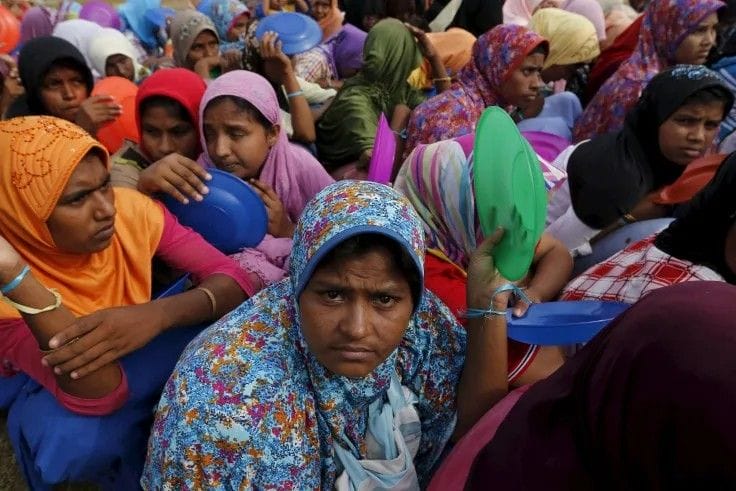
Many Rohingya Muslims, including single widowed mothers, live in squalid shanty clusters across Jammu.
As Myanmar’s neighbour and as a signatory to the global Sustainable Development Goals (SDGs), India has an important role to play in not only finding a sustainable solution to the whole problem but in also supporting Rohingyas struggle for securing justice at the international level. India should ideally ensure that those Rohingyas who now live in India are not subject to further abuse or discrimination. Yet, the Rohingyas continue to live in deplorable conditions.
They gang-raped her. She managed to escape with her three children, but her fourth child – a 4-year-old boy – got left behind and was killed by the Burmese. After that, staying in the village was unthinkable.